




- My Forums
- Tiger Rant
- LSU Recruiting
- SEC Rant
- Saints Talk
- Pelicans Talk
- More Sports Board
- Coaching Changes
- Fantasy Sports
- Golf Board
- Soccer Board
- O-T Lounge
- Tech Board
- Home/Garden Board
- Outdoor Board
- Health/Fitness Board
- Movie/TV Board
- Book Board
- Music Board
- Political Talk
- Money Talk
- Fark Board
- Gaming Board
- Travel Board
- Food/Drink Board
- Ticket Exchange
- TD Help Board
Customize My Forums- View All Forums
- Show Left Links
- Topic Sort Options
- Trending Topics
- Recent Topics
- Active Topics
Started By
Message

Outlook Towards Taysom Hill's Recovery Timeframe
Posted on 1/15/22 at 1:15 pm


Posted on 1/15/22 at 1:15 pm
Lisfranc injuries are possibly the toughest injury for a football player successfully rehab from. The recovery timeframes are from modest to really long. There's going to be a certain percentage of fans who are going to mistakenly assume that Hill's recovery timeframe is going to be that of an ACL or Achilles but that's not the case here.
Taysom's first Lisfranc while at BYU was a 10-11 month recovery & based on this article, it seems that his latest one may fall into that same category. This sucks because he's been a vital part of the team’s success over the past 4 seasons.
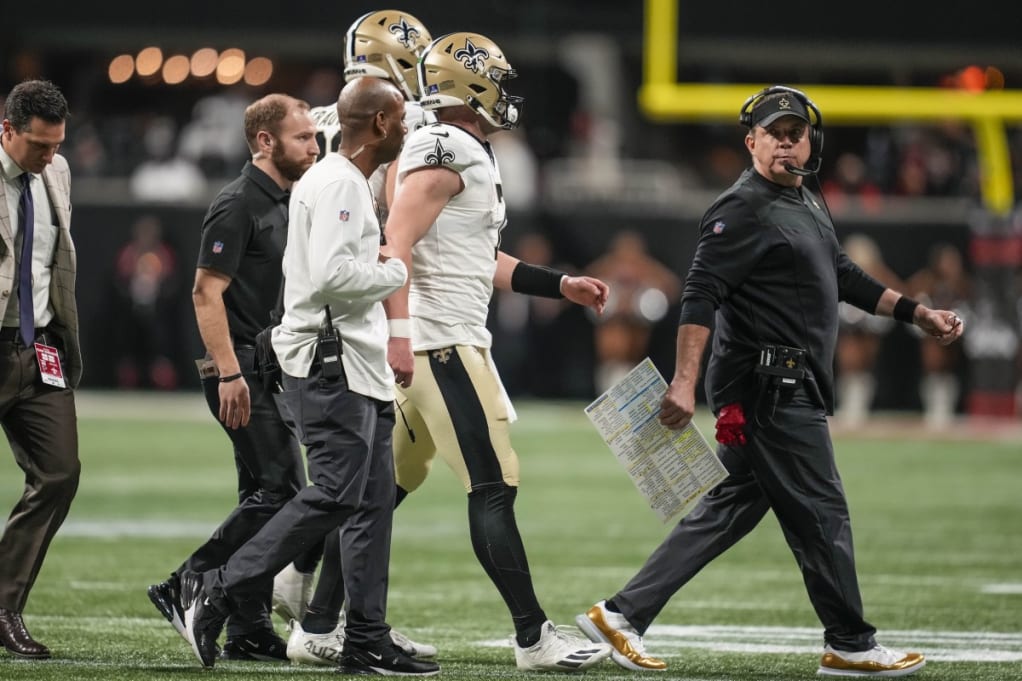
Understanding Taysom Hill's Lisfranc Prognosis & Outlook
Taysom's first Lisfranc while at BYU was a 10-11 month recovery & based on this article, it seems that his latest one may fall into that same category. This sucks because he's been a vital part of the team’s success over the past 4 seasons.
quote:
Taysom Hill is going to have to recover this offseason from injuries, but none bigger than a Lisfranc injury. So, what's all that mean, and what is the prognosis and outlook for the Saints quarterback?
quote:
"Yeah, it's a Lisfranc," Payton said.
"He actually had one, he just was up here we were talking. He had one before in his right foot so when he planted, because I didn't see how it happened, but when he planted with his left foot he felt something. My take is they will have to do a surgery. That's what I heard today. So it's a Lisfranc. They'll repair that area and then do a smaller surgery to remove the hardware after it's healed."
quote:
What does that actually mean?
We connected with Scott J. Ellis, MD, a foot and ankle surgeon at the Hospital for Special Surgery. The idea was to get a better understanding of the injury, the impact for Hill, and how things could potentially play out going into the next season. Understand that Ellis has not seen nor treated Hill, but the HSS is nationally ranked No. 1 in orthopedics by U.S. News & World Report (2021-2022) and is a world leader in sports medicine performance and rehabilitation.
quote:
With the surgery option Sean Payton described (repair and remove hardware), what type of injury severity would Hill have likely suffered?
The different types of Lisfranc injuries include purely ligamentous injuries of the midfoot (i.e. tears of those ligaments otherwise termed more generally “sprains”) and combined bone + ligamentous injuries in which there have been fractures of the metatarsals or cuneiforms in addition to the ligamentous tears. Other classification systems describe how much widening has occurred between the first and second metatarsal, with the worst injuries demonstrating more widening. I highly suspect this was a purely ligamentous injury given that he was able to walk off the field and because the surgery proposed was the placement (ORIF) and subsequent removal of screws. With more severe injuries involving bone, joint fusion is more often considered in which case the screws do not need to be removed.
quote:
Are there multiple options to repair a Lisfranc injury, or would this be the most straightforward approach?
The two options for treatment generally are ORIF in which case the joints of the midfoot are put back into position (i.e. “reduced”) and then held with screws to allow for healing versus fusion in which case the joints of the midfoot are fused. There is debate as to which is better. However, ORIF is generally done for lesser and more ligamentous injuries whereas fusion is indicated in injuries with bone fractures and more severe ligamentous injuries. The more straightforward is probably the screw fixation described for Taysom. There are benefits to both ORIF (preservation of joints) and fusion (stable healing, no need to remove screws) but it is constantly debated among Foot and Ankle Orthopaedic Surgeons. With ORIF, the screws need to be removed at a second much smaller surgery.
quote:
What is the typical timetable for recovery on this particular procedure?
The timetable can vary depending on the severity of injury, with worse injuries and those requiring fusions probably taking longer to recover. With ORIF and screw removal, it is possible that players could return to play around 5 to 6 months after the injury. However, the average return to play demonstrated in studies is 10 to 11 months which I think is a more realistic timetable.
Some have speculated that this type of injury could make Hill's outlook for being a mobile quarterback questionable. Are there specific setbacks or issues that we should look for?
If the bone heals well and in the correct position, Hill probably can make a return. Studies show that roughly 80 to 90 percent of NFL players will return to full competition after a Lisfranc injury. More specific studies indicate that defensive players are more likely to return than offensive players, but this does not include quarterbacks who can potentially function well without constant sprinting or running.
Understanding Taysom Hill's Lisfranc Prognosis & Outlook
 1
1


Posted on 1/15/22 at 1:50 pm to BigBrod81
I still do not comprehend that extension at all.

 Page 1 of 1


Popular
Back to top
 Follow TigerDroppings for LSU Football News